
Don't Get Burned: Fire Extinguishers in the Kitchen and on the Jobsite

David Talley • April 26, 2024

Share this article

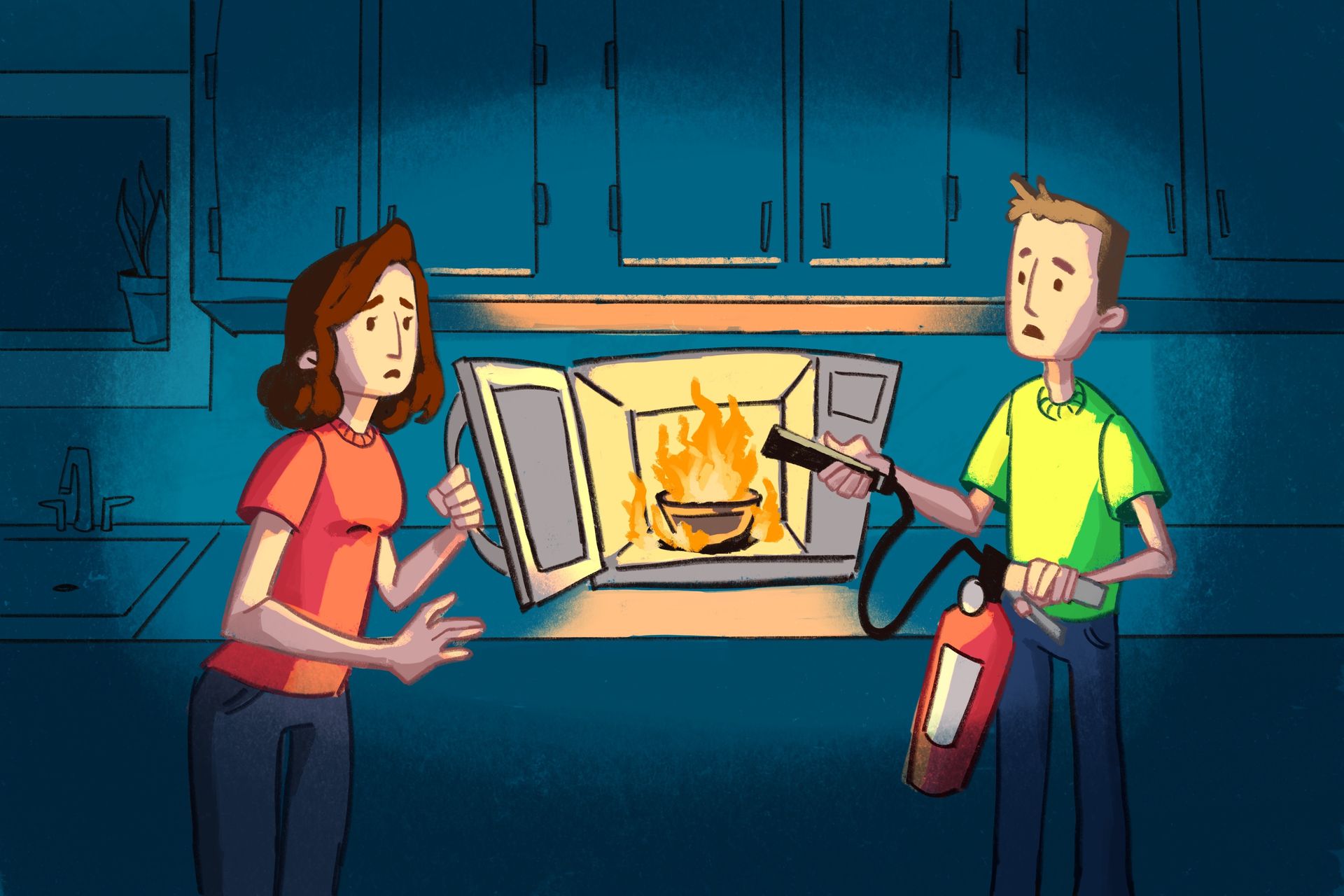
In my arms, I held my eight-month-old son. In my microwave, flames rose from an old potholder under a glass bowl of steamed carrots.

"The microwave is on fire," I shouted to my wife, who was out of the room readying our son's bath.

She quickly ran to the kitchen, which was already filling with smoke and foul smells.

Inside the microwave, the glass bowl audibly shattered.

Two people inspect a kitchen oven with flames inside, one holding a fire extinguisher.

What happened next was a blur. We worked together, unspeaking and efficient, like a SWAT team in sweatpants. I set my son down on his playmat in the living room, far away from the action in the kitchen. My wife grabbed our fire extinguisher from the pantry and passed it to me. She positioned herself to the side of the microwave door. I pulled out the fire extinguisher's locking pin. We locked eyes. She opened the microwave. I squeezed the trigger and the expellant struck the potholder and extinguishing the fire.

Looking back, this could have gone a lot worse. The fire was small and contained to the microwave. The casualties were an old potholder, a glass bowl, and some steamed carrots. Our household fire extinguisher was readily accessible and worked flawlessly.

Situations like this highlight the importance of keeping a fire extinguisher on hand, whether in a suburban kitchen or in the field working on a pipeline. In this blog post, we'll cover types of fire extinguishers, the importance of fire extinguisher inspections, and the PASS Method for extinguishing fires.

Types of Fire Extinguishers

All commercially available fire extinguishers are labeled A, B, C, D, or K to indicate the class of fire they can extinguish. Some extinguishers are capable of extinguishing more than one class of fire.

  • Class A Fire Extinguishers are for burning wood, paper, trash, and other combustible solids
  • Class B Fire Extinguishers are for fires that are burning flammable liquids, such as gasoline, solvents, and aerosols
  • Class C Fire Extinguishers are for electrical fires started by loose connections, damaged wire insulation, or overloaded electrical components
  • Class D Fire Extinguishers are for fires fueled by combustible metals like magnesium and titanium
  • Class K Fire Extinguishers are for kitchen fires like those fueled by cooking oils, like olive oil, butter, or bacon grease

What type of fire extinguisher do you have in your facility? What about in your home? It's worth checking to make sure you have the right fire extinguisher for the types of fires you might encounter.

Inspection

When my microwave caught fire, I was fortunate that my fire extinguisher didn't just match the fire type but that it also worked when I needed it most. Fire extinguishers in commercial facilities must be inspected regularly to ensure they'll work when needed, too.

When was your facility's fire extinguisher last inspected? What about the fire extinguisher in your home? Fire extinguishers should have a tag with a log on the handle. Inspecting a fire extinguisher typically involves ensuring that it's in good condition and that the pin is sealed to the handle (which indicates that the extinguisher has not been used).

PASS Method

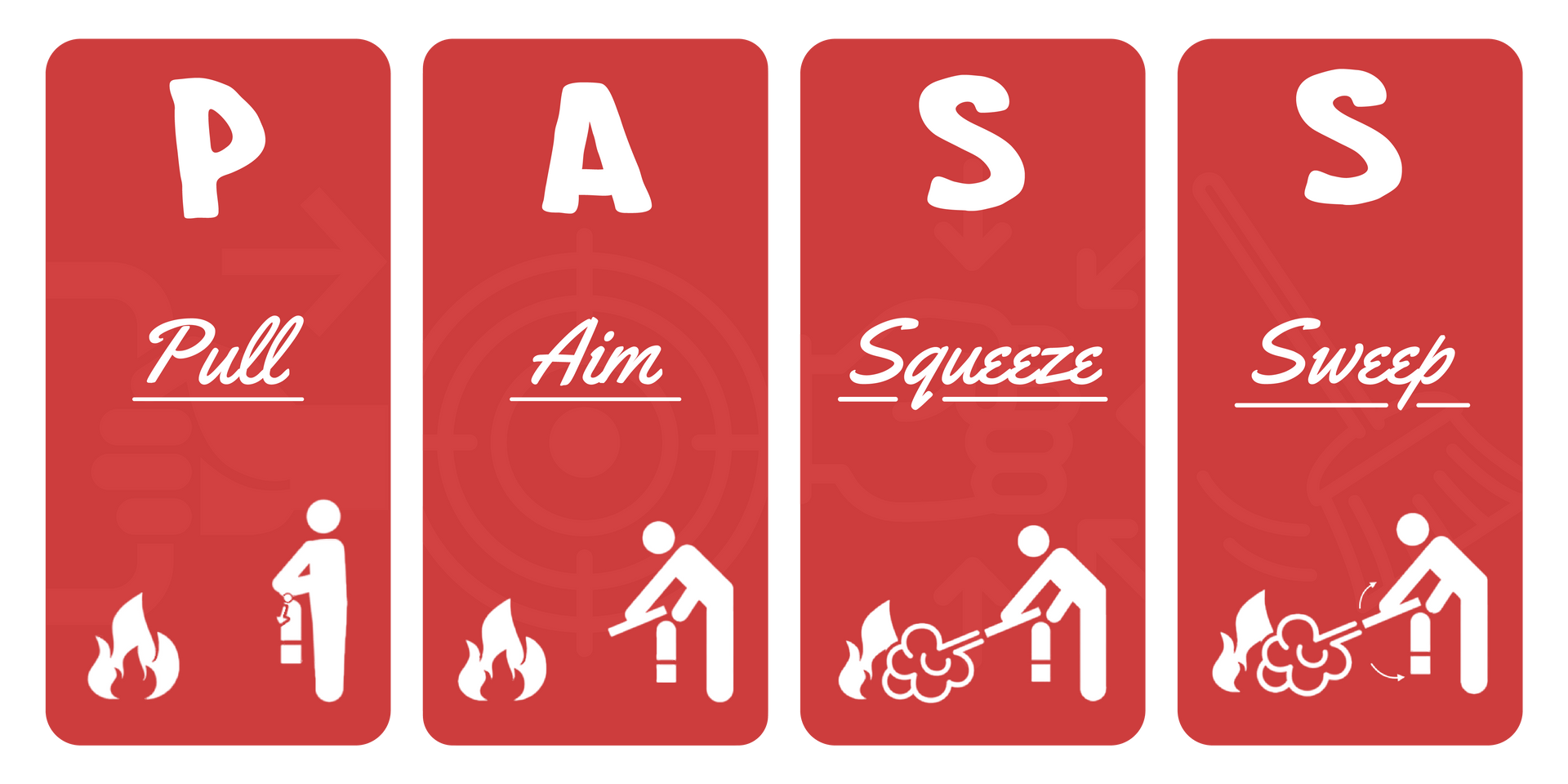
PASS is a common acronym for remembering the basic steps for using a fire extinguisher. PASS stands for:

  • Pull the pin to unlock the extinguisher handle, which acts as a lever to release the expellant
  • Aim the extinguisher or hose at the base of the fire
  • Squeeze the extinguisher handle slowly while bracing yourself to counteract the force of the expellant
  • Sweep the expellant steadily across the base of the fire until the fire is extinguished

Red PASS fire extinguisher steps poster: Pull, Aim, Squeeze, Sweep, with extinguisher icons.

Finally, after the fire is out, watch the area for a few minutes to be sure the fire is completely out. Smoldering embers can sometimes reignite the fire.

Want to learn more?

Energy Worldnet offers computer-based training that can enhance your knowledge and safety on the worksite and at home.

New to EWN? Interested in more information on fire extinguisher safety? Contact us today!

Already a client? Click here or talk to your account manager for more details.

Energy Worldnet strives to be the most trusted provider of Operator Qualification (OQ) training and helps Operators meet their OQ and OSHA compliance needs. We have an extensive library of pre-written OQ courses and offer custom training content to fit an Operator's OQ program's specific needs.

Recent Posts

By Kevin Speicher July 24, 2026
PHMSA just issued ADB-2026-06, an advisory bulletin reminding gas distribution operators of their existing obligations under 49 CFR Part 192, subpart P.

By Kevin Speicher July 22, 2026
On July 30, 2026 PHMSA is bringing the Gas Pipeline Advisory Committee & the Liquid Pipeline Advisory Committee together for a virtual meeting.
By Energy Worldnet (EWN) July 10, 2026
EWN's Regulatory Advisory Group breaks down RP 1173, PHMSA's new leadership, ECA rulemaking, multi-state OQ compliance, and PSMS for small operators.
By Kevin Speicher June 24, 2026
PHMSA's new approach of issuing 40+ targeted rulemakings instead of mega rules, and what the substantive changes mean for pipeline operators.
By Kevin Speicher June 24, 2026
PHMSA's Technical Pipeline Safety Standards Committee (GPAC) met on May 28, 2026, to work through the Safety of Gas Distribution Pipelines rule. Here's what happened and what operators need to know.
By Kevin Speicher June 19, 2026
Span of control refers to the practice of allowing an unqualified worker to perform a covered task while being directed and observed by a qualified person.
By Energy Worldnet (EWN) May 27, 2026
Former PHMSA leaders discuss PSMS, OQ, safety culture, contractor oversight, and the future of pipeline safety and compliance.
By Kevin Speicher April 30, 2026
PHMSA reinforcing sharper operational expectations: excavation damage remains one of the leading threats to pipeline safety.
Compliance Leadership Forum title slide on a dark blue screen with yellow and white text.
By Ashley Jesko February 26, 2026
Energy Worldnet (EWN) hosted the first-ever Compliance Leadership Forum (CLF)—a peer-to-peer space designed for candid, practical conversations about pipeline compliance and safety. Hosted by James Cross (Chief Experience Officer, EWN), the session brought together more than 150 years of combined experience from former state and federal regulators and industry leaders. Meet the panel Kevin Speicher, Senior Regulatory Advisor, EWN; former Chief of Pipeline Safety, New York State Department of Public Service Steve Allen, former Director of Pipeline Safety, State of Indiana; longtime PSMS advocate and former EWN executive Alan Mayberry, former PHMSA Associate Administrator, now with Jana and serving on boards focused on advanced risk and geohazards Jeff Wiese, former PHMSA Associate Administrator; former offshore operations leader; longtime safety management advocate The tone was clear from the start: no judgment, anonymous questions, and a focus on what operators can actually do next.
EWN PHMSA Update graphic with “Read More” on a dark teal background
By Kevin Speicher February 19, 2026
PHMSA has issued Advisory Bulletin ADB-2026-04, reminding gas pipeline, underground natural gas storage (UNGS), and LNG operators that incidents must be reported to the National Response Center (NRC) at the earliest practicable moment — and no later than one hour after confirmed discovery.

Show More